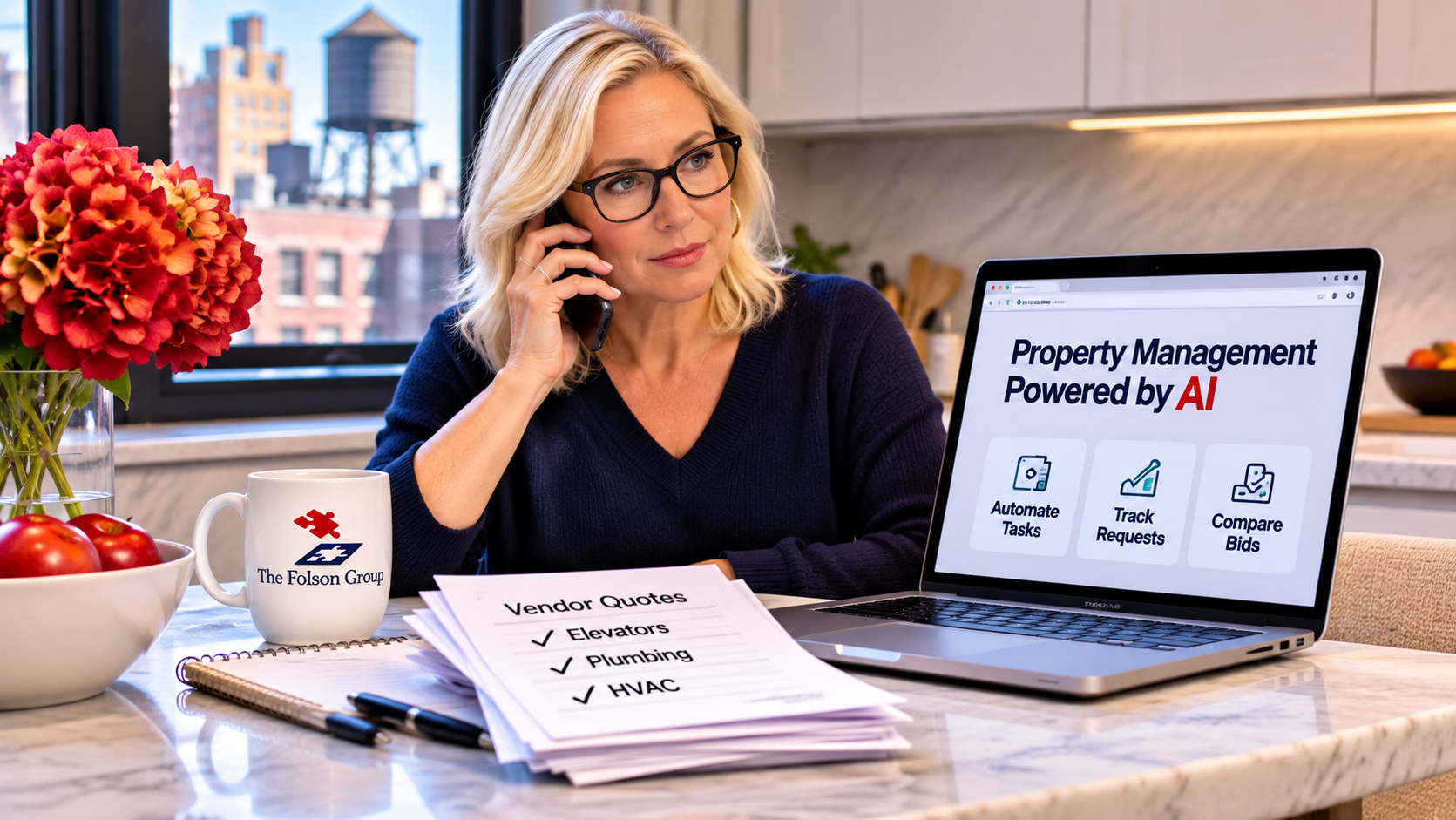
NYC condo board member reviewing vendor quotes while exploring AI-powered property management technology on a laptop.
You said yes to the board because nobody else would. Maybe you stepped up at the annual meeting because you care about your building. You expected the management company to handle the day-to-day. That's what it's paid to do.
Instead, your weekends look like this: calling around for vendor quotes, waiting in the lobby for a contractor who's running late, and rereading the governing documents to figure out who is responsible for a leaking pipe. Meanwhile, it feels like the board is paying for help it isn't getting, and response times don't match what you expected.
You've switched firms once, maybe twice. Nothing really changed. And now you're hearing about firms that use AI to work faster and smarter.
So, should your board hire one?
The question is timely. In a November 21, 2026, article in The New York Times, titled "My Condo's Management Company Is Inept. Could A.I. Do a Better Job?", I was asked to weigh in on what boards should expect when management companies use AI.
My point was simple: efficiency should benefit the building, not just the management company.
As I told the New York Times:
"If the fee is the same and the board is still doing the work, the A.I. is helping the firm, not the building."
It's a distinction worth keeping in mind as more management companies promote their technology.
Why Didn't Switching Management Companies Help?
AI is a tool. It is not a reason to hire a firm. Used well, technology can make a management company faster and more accurate. But it can't fix a problem it was never pointed at.
If your board has changed firms more than once and is still collecting its own bids and chaperoning vendors, the issue might not be the firm. It's that management agreements often leave the day-to-day work loosely defined, so the board and the firm end up with different expectations.
When a board pays a high fee and still gathers its own quotes and oversees vendors, those tasks often aren't spelled out in the agreement. A new firm starts under a similar agreement, the same gray areas carry over, and the work lands back on the board.
That's why even a firm with excellent technology, hired on the same loosely defined terms, can leave both sides with the same frustration.
No software fixes a contract that leaves the work with the board.
How Can We Tell How a Firm Actually Uses AI?
When a firm mentions AI, ask: "How do you use technology to cut costs or improve service for our building?"
A firm that's using it well will get specific. They might describe coding invoices, comparing vendor bids side by side, or tracking owner requests so nothing falls through the cracks. Then they'll tell you what that means for your building: hours saved, faster turnaround, lower costs.
A firm that's still early with technology may answer in more general terms. That's fine. But then AI shouldn't be the reason you choose it.
Either way, the answer tells you how much weight technology should carry in your decision.
What Does Our Management Fee Actually Cover?
This is the question to spend the most time on: "What is your management fee, and exactly what does it include?"
For a board in your position, the answer needs to land on the very tasks that have been eating your weekends. Is soliciting bids part of the base fee? Is overseeing vendors on site? If not, what does it cost, and who decides when it's needed? Get it in writing.
And the fee is only part of it. The tasks the firm is responsible for, how quickly it has to respond to the board and residents, and what happens when it falls short all belong in the contract, too. Writing them down protects the board and gives the firm a clear target.
Each of those points opens up more questions. What counts as "oversight"? What's a reasonable response time for an emergency versus a routine request? What's a fair, workable way to handle it when expectations aren't met? That's where the important details are, and they're easy to skip past in an introductory meeting.
If AI Saves the Firm Time, What Should Our Building Get?
Say a firm really does use AI well. In a good partnership, that efficiency benefits both sides.
If technology saves a firm time, your board should share in that benefit. That could mean a lower management fee, but realistically, who is going to lower their own fee? Instead, it could mean faster, more thorough service for the same price. What matters is that the board feels the difference, too.
Here is how I put it to boards:
"If the fee is the same and the board is still doing the work, the AI is helping the firm, not the building."
What Should Our Board Fix Before the Next Switch?
If you've been through a few firms already, it's natural to want a firm that will finally make things easier. You're a volunteer, and this is a lot.
Often the fix isn't a different firm. It's a clearer understanding of responsibilities and setting expectations. That gives any good firm, AI or not, the best chance to succeed.
It's easy to underestimate how much has to be defined to get there.
If your board is starting to look at new management, our free guide, 100 Questions to Ask a Property Manager or Managing Agent Before You Hire Them, is a good place to begin. You'll find it, along with more guidance for boards, in our Property Management Hub.
And if you'd like a few quick tips for your board's situation, I'm always happy to chat. You can grab a time on my calendar here.
By Tina Larsson, CEO and Co-Founder of The Folson Group
Tina Larsson is CEO and co-founder of The Folson Group, a New York City consulting firm that advises co-op and condo boards on property management, cost reduction, project management, and strategic decisions. Her insights on AI in property management have been featured in The New York Times.