
Choosing a New Management Company, With an Independent Advisor on the Board's Side

We Work for the Boards
We help boards of HOAs, condos and community associations nationwide compare management companies, settle the business terms, and move through the handover with a clear plan. We advise the board; we never manage the community.
Why Boards Trust The Folson Group
12+ years advising boards.
First-hand experience with property managers across 100+ engagements with condo, HOA, and community association boards.
Our team includes a sitting board president.
Hired by the board and reporting only to the board, from the first call through the handover.
Closely involved in the transition, the stage boards tend to worry about most.
“On behalf of the entire Board, thank you for your fine work on this assignment. You made the task far more comprehensive and efficient than we could have on our own. We appreciate the service and professionalism. Bravo!”
“I am here to tell you from experience that the best decision any coop or condo board can ever make is to contract with Folson… if you would like to exhale and get your life back and go in the right direction, definitely call The Folson Group.”
What's Included: Five Steps from First Call to New Management
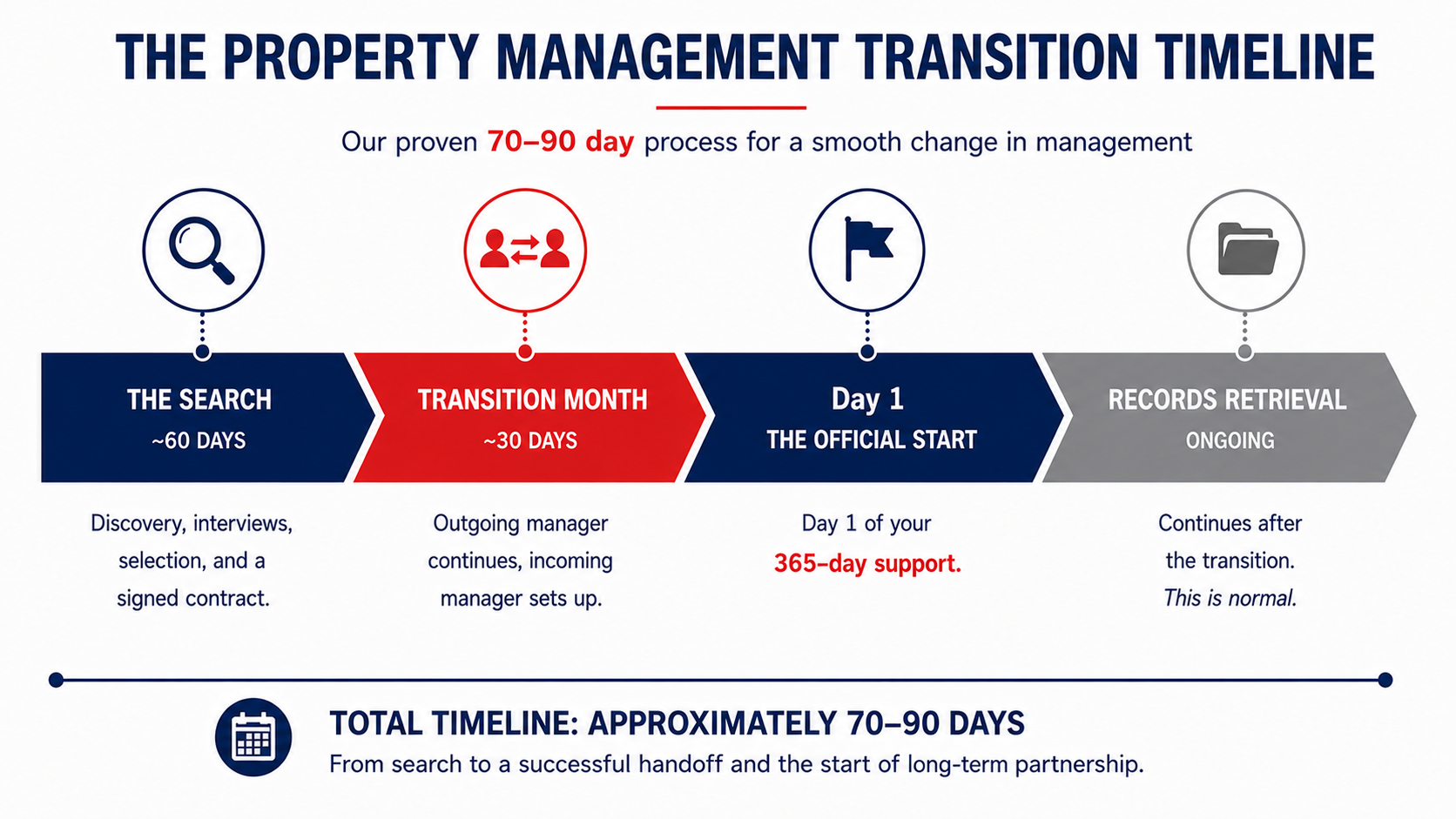
Every search follows the same five steps, adjusted to the size of your community, how it is governed, and what your board needs from a management partner. Most boards reach the first day of new management about 70 to 90 days after we begin.
1. Getting Clear on What Your Community Needs
We start by listening. In working sessions with the board, we talk through your community's makeup (number of homes, shared amenities, age of major systems, how the association is set up), what is going well today, what isn't, and what the board expects week to week. Often the real issue turns out to be a scope or set of expectations that was never written down. We capture all of it in a written brief the board approves, so every company responds to the same picture.
2. Building a Shortlist and Requesting Proposals
Using that brief, we identify management companies that look like a good match for your type and size of community and that are active in your area. Each one receives the same proposal package and the same questions, which makes their answers far easier to line up later. Your board doesn't have to handle a stream of cold calls along the way.
3. Comparing Proposals and Meeting the Finalists
As proposals come in, we bring them together in one comparison covering scope of services, staffing, who your day-to-day manager would be, reporting, technology, response commitments and overall cost. We flag gaps and anything that needs a clearer answer. Then we organize and run finalist meetings with the board and help members talk through what they heard right afterward. The choice is always the board's.
4. Negotiating the Business Terms
Once the board has a preferred company, we negotiate the business side of the agreement on the board's behalf: fees, staffing levels, the scope of work and response times. The board's own attorney takes care of the legal terms. Each part of the agreement stays with the right advisor.
5. Guiding the Transition
For most boards, the handover is the biggest concern, and it is where we put real effort. We work between the outgoing and incoming companies from a shared checklist: financial records, bank accounts and reserves, keys and access, service contracts, open work, and notices to owners and residents. We track every item, follow up on anything running late, and keep the board updated at each stage. The two management companies carry out the handover; we keep it organized and report to the board on where things stand.
Before We Sign Off: Three Onboarding Milestones
Our work on the transition doesn't stop on the new company's first day. Before we consider it complete, we confirm three milestones with the board and the new management team:
Critical building systems and open repairs. Service agreements, maintenance records and any repairs in progress for the community's key systems have been handed over with their history, so the new team starts with context instead of guesswork.
Owner accounts and payments. Every owner's balance has carried over correctly, owners can make payments, and the board's invoice approval process is set up and working the way the board wants.
Accountant access. The association's accountant confirms they can get into the books under the new company, so year-end work and the next review or audit stay on schedule.
Oversight After the Transition
Once the milestones are confirmed, we stay on in an oversight role for the board: checking in on how the new relationship is settling in, following up on items still owed by the previous company, and helping the board raise questions early. This is oversight on the board's behalf, not management. The new company remains responsible for running the community.
How Long It Takes
Most searches take about 70 to 90 days from our first discovery session to the first day of new management. The general sequence:
Discovery and brief: the board's priorities are agreed and written down.
Shortlist and proposals: suitable firms are invited and proposals collected.
Comparison and finalist meetings: the board reviews its options and makes a choice.
Negotiation: business terms are settled, with legal terms left to the board's attorney.
Notice and handover: the current company receives notice under its agreement, and the incoming company prepares to start.
The exact pace depends on how often your board can meet and the notice terms in your current agreement.
FAQs
-
It's independent help for a board that wants to hire a management company. A search advisor is not a management company and doesn't take over any part of running the community. Instead, we organize the process for the board: defining needs, finding suitable firms, gathering and comparing proposals, running finalist meetings, negotiating business terms and guiding the handover. The board makes every decision; our job is to make sure it has clear, comparable information to decide with.
-
There's no single trigger. Boards usually start asking the question when:
The community's needs have shifted (it has grown, aged, or taken on bigger projects) and the current arrangement no longer fits.
Expectations around scope, reporting or response times were never spelled out, and the gap keeps causing friction.
Financial reporting or communication doesn't match how the board prefers to work.
Board members are spending much more of their own time on day-to-day matters than they expected.
A good first step is an honest look at the current agreement and expectations. Sometimes a clearer scope settles things; sometimes a different fit is the better answer. We can help the board think it through.
-
Changing your manager means asking your current company to assign a different person to your community. Changing companies means ending the agreement with the firm and hiring a new one.
A new manager may be enough when the board is comfortable with the company's systems, reporting and support, but the working relationship with the assigned individual isn't the right fit.
A new company may make more sense when the questions are about the firm's service model, systems, staffing approach or overall fit with your community.
We help boards work out which situation they're in before committing to a full search.
-
Typically about 70 to 90 days, counting from discovery through the first day of new management. The notice terms in your current agreement and how often your board can meet are usually the two biggest factors. Starting early gives the board room to weigh options without time pressure.
What should a board look for in a management company?
Experience with communities like yours: similar size, type and amenities.
The person as well as the firm: who your day-to-day manager will be, how many communities they look after, and who covers when they're away.
Local presence: enough activity nearby to visit regularly and know local service providers.
Clear financial reporting: reports the board can read and rely on, delivered on a set schedule.
Technology people will actually use: for owner payments, requests and board approvals.
Clarity on cost: what's included, what's billed separately, and any other compensation, disclosed in writing.
Licensing and compliance: meeting the requirements in your state, which differ from place to place.
-
Yes, and some do. It helps to plan for three things: the time involved (board members are volunteers fitting this around work and family), the challenge of comparing proposals written in different formats, and the coordination a handover requires. An advisor takes on the organizing and comparison work and stays with the board through the transition, so members can focus on the decision itself.
-
Neither is better in every case. It depends on your community.
Larger firms may bring deeper staff benches, established systems and broad in-house resources. Boards will want to understand who their day-to-day contact is and how decisions get made.
Smaller firms may offer closer access to principals and more flexibility. Boards will want to understand backup coverage and how the firm handles growth or staff changes.
We focus on fit: which firms are well matched to a community of your size and needs, whatever their own size.
-
The outgoing company hands over to the incoming one: financial records and bank accounts, owner balances, contracts and warranties, keys and access, open repairs and projects, and the community's history that might otherwise be lost. Owners and residents are told about the change and how to reach the new team. We stay closely involved throughout, tracking the checklist, following up on late items and keeping the board updated, and we confirm three onboarding milestones before we sign off. The management companies do the work; we keep the process organized for the board.
-
Yes. We work with HOA, condo and community association boards throughout the US. Outside New York, we serve as the board's search and advisory partner and provide oversight only after the transition. We never act as your property manager, and we don't direct staff, handle vendors or run the community. Licensing rules for community association management differ from state to state, and we do not provide legal services; legal questions go to your board's attorney.
Ready to Explore a Change?
In New York? Visit our NYC property management search.
The Folson Group provides independent search and advisory services. We do not act as a property manager or provide legal services. Licensing rules for community association management vary by state.