
Property Management Search Consultants for NYC Co-op & Condo Boards

We Work for the Boards
Unlike property management companies, we don't manage your building’s daily operations, we help you find the one who should.
Why Boards Trust The Folson Group
12+ years advising NYC co-op and condo boards
100+ successful property management transitions
Co-op owners and board members ourselves, we know what it's like to sit on your side of the table
Featured in: Habitat Magazine, The Cooperator, New York Times, The Real Deal, Gothamist
“On behalf of the entire Board, thank you for your fine work on this assignment. You made the task far more comprehensive and efficient than we could have on our own. We appreciate the service and professionalism. Bravo!”
“I am here to tell you from experience that the best decision any coop or condo board can ever make is to contract with Folson… if you would like to exhale and get your life back and go in the right direction, definitely call The Folson Group.”
What's Included in Our Property Management Search Service
The Folson Group provides comprehensive property management search services for NYC co-op and condo boards. Our end-to-end process typically takes 90 days and includes:
1. Discovery & Needs Assessment
We begin with an in-depth meeting to understand your building's specific challenges, priorities, and requirements. This discovery phase covers your current management pain points, building profile (size, location, complexity), service level expectations, budget parameters, and timeline constraints. The result is a comprehensive needs assessment that guides our entire search process.
2. Custom RFP Development & Strategic Shortlisting
We create a detailed Request for Proposal tailored to your building's unique needs, then distribute it exclusively to 5 pre-qualified property management firms. Unlike open RFPs that attract dozens of unsuitable companies, our strategic shortlisting ensures you only interview firms we've already vetted for expertise with your building type, geographic coverage in your area, appropriate service model, and cultural fit with your board.
3. Proposal Analysis & Comparison
We collect proposals, then conduct comprehensive analysis comparing fee structures, scope of services, staffing commitments, technology platforms, compliance capabilities, and contract terms. We create a side-by-side comparison matrix that eliminates the "apples to oranges" problem and identify red flags like hidden fees or vague commitments.
4. Interview Coordination & Moderation
We schedule and moderate a streamlined 2-hour interview session over Zoom with your top 3 finalist firms (30 minutes each), followed by an immediate debrief where we help your board make the final decision while impressions are fresh.
5. Contract Negotiation & Transition Management
We negotiate contract terms on your behalf, then manage the complete handoff from your outgoing firm to your new one: document retrieval, access transfer, stakeholder communication, and operational continuity. And we don't consider the engagement done when the boxes of files arrive. Before we close out, we sign off on three onboarding milestones with your new management team, detailed below.
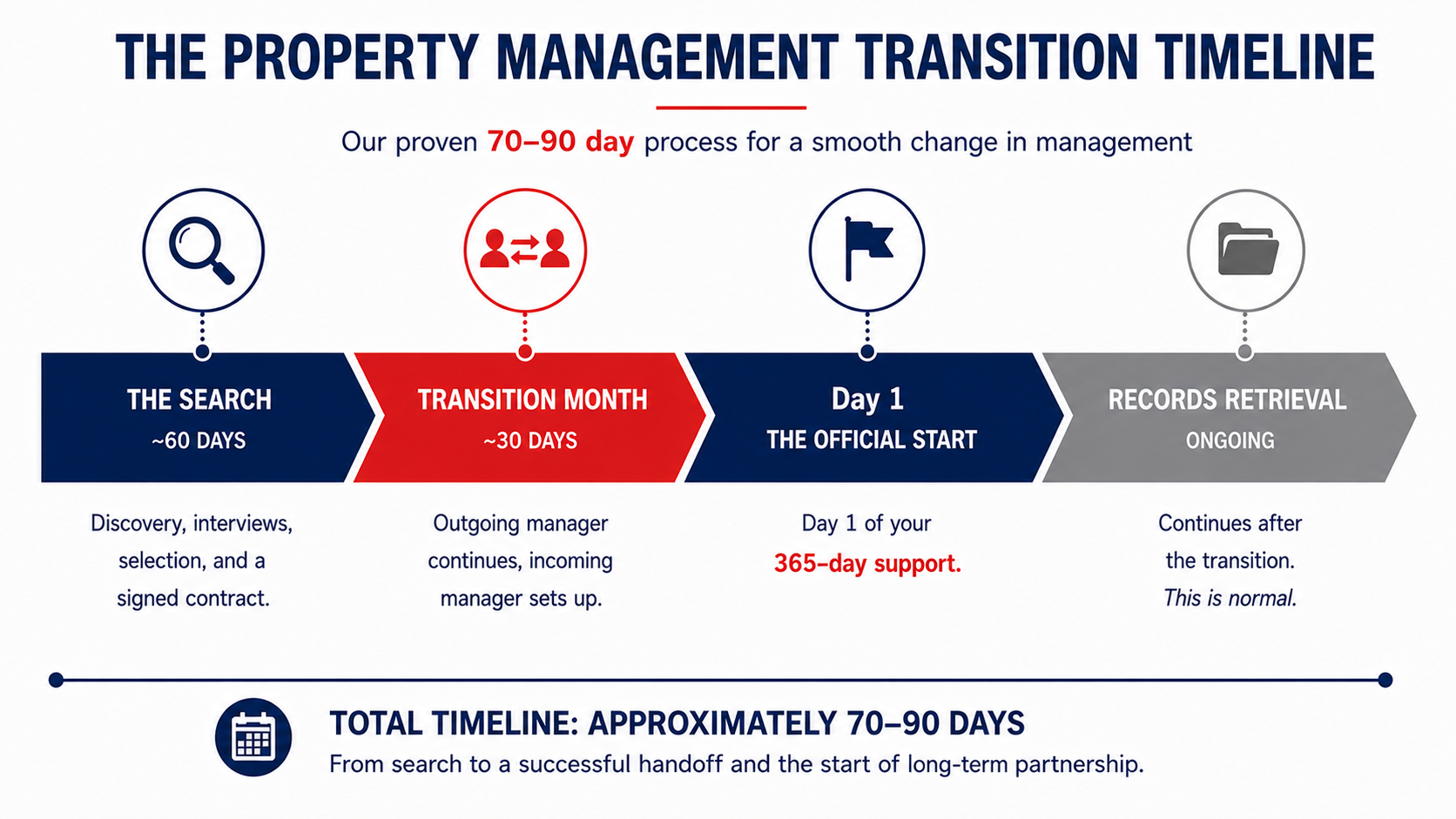
Timeline: The search takes about 60 days from discovery to a signed contract. Then comes the transition month: your outgoing firm receives its 30-day notice and continues managing day-to-day while your new firm sets up bank accounts and your financial portal. The first of the following month is day one of new management, roughly 90 days from when we start. That's also day one of our 365-day support, because collecting records from the outgoing firm often continues for months, and your board shouldn't be the one chasing them.
What's included: Everything described above is covered in our one-time consulting fee, including unlimited board consultations, RFP development, proposal analysis, interview moderation, contract negotiation, transition management, and 365-day post-transition support.
Our Transition Sign-Off: Three Onboarding Milestones
A management change succeeds or fails in the first 90 days, so we hold your new firm accountable to three milestones before we sign off:
Building systems onboarding. Service contracts and open work orders for your most critical equipment, elevator, boiler, and any active leak repairs, are transferred with their full history, so your new manager inherits the building's problems with context instead of discovering them mid-emergency.
Owner accounts and payment systems. Every unit's account carries over accurately, and your payable system is set up and configured to meet your desired approval process.
Accountant access. Your CPA has confirmed access to the books under the new firm, so year-end closes on schedule and your next audit starts clean instead of starting with a reconstruction project.
This sign-off, plus 365 days of post-transition support, is included in our one-time consulting fee.
FAQs
-
A property management search service is an independent consultancy that helps co-op and condo boards find and hire the right property management company for their building. Unlike property management firms that manage buildings directly, a search consultant works exclusively for boards to evaluate, compare, and recommend management companies.
The Folson Group's property management search service includes conducting a discovery call with the board, a comprehensive RFP process, shortlisting qualified firms, coordinating interviews, negotiating contract terms, and overseeing the transition to new management. The entire process typically takes 70-90 days.
This service is particularly valuable because search consultants have insider knowledge of how different management firms actually perform, information that isn't available through public reviews or firm marketing materials. Boards get unbiased recommendations based on their building's specific needs, size, location, and budget rather than relying on sales pitches.
-
Co-op and condo boards should consider changing property management companies when they experience persistent issues that affect building operations or resident satisfaction. Common signs include:
Performance issues: Property manager is consistently unresponsive, financial reports are late or unclear, compliance deadlines are missed resulting in violations, or vendor relationships appear questionable.
Communication breakdown: Board requests are ignored, concerns are dismissed, or the manager is rarely available for urgent matters.
Financial red flags: Unexplained cost increases, lack of transparency in billing, missed tax abatement opportunities, or poor budget forecasting.
Resident complaints: Increasing complaints about management responsiveness, maintenance delays, or unprofessional conduct.
Excessive board time: Board members spending more time on operational tasks that should be handled by management.
Before making a change, boards should first evaluate whether issues stem from the specific property manager (who could be replaced by the firm) or the management company's systems and culture (requiring a full firm change). The Folson Group helps boards diagnose the root cause and determine the appropriate solution.
-
Changing property managers or managing agents means requesting a different individual from your current management company to handle your building, while changing property management companies means terminating your contract with the entire firm and hiring a new company.
When to change just the manager: If you're satisfied with the management company's systems, responsiveness, and overall performance but have personality conflicts or communication issues with the specific individual assigned to your building, requesting a new manager is often sufficient. Most firms will accommodate this request.
When to change the entire company: If problems stem from the firm's policies, systems, fee structure, corporate culture, or overall service quality, changing managers won't solve the underlying issues. This requires a full company change through an RFP process.
The Folson Group helps boards diagnose whether the problem is individual or systemic, then recommends the appropriate path forward.
-
Changing property management companies in NYC typically takes 70-90 days from initial decision to new management. The timeline breaks down into:
Weeks 1-2: Discovery and assessment of building needs, creation of RFP, shortlisting of qualified firms
Weeks 3-4: RFP distribution and proposal collection from management companies
Weeks 5-6: Proposal analysis, board interviews with shortlisted firms, reference checks
Weeks 7-8: Final selection, contract negotiation, notice to current management firm
Weeks 9-12: Transition period including the start of document transfer and resident communication.
At the end of this, new management starts, typically 70-90 days after the start of the search.
Rushing the process often leads to poor decisions, while starting early allows time for thorough evaluation. The Folson Group manages the entire timeline to ensure each phase receives appropriate attention without unnecessary delays.
-
NYC co-op and condo boards should evaluate property management companies across seven critical dimensions:
1. Building type expertise: Firms specialize in different building sizes, co-op vs. condo structures, and property types (luxury, middle-market, HDFC). Your building should align with their sweet spot.
2. Service model fit: Determine whether you need full-service management, back-office only, or hybrid models. Ensure the firm's standard approach matches your expectations.
3. Geographic coverage: Property managers should have other buildings in your area for efficient site visits and vendor relationships. Being their only building in your borough often leads to neglect.
4. Technology and systems: Evaluate their financial reporting, resident portals, work order management, and communication platforms. Advanced systems matter less if they're not user-friendly.
5. Staffing and backup coverage: Understand who will actually service your account, their experience level, backup coverage for vacations/sick days, and typical manager workload.
6. Financial structure: Compare not just monthly fees but project management markups, vendor relationships, insurance commissions, and total cost of management.
7. References and track record: Check with buildings similar to yours (size, location, complexity), focusing on longevity of relationships and reasons any buildings have left.
The Folson Group evaluates all these factors using our decade of industry experience to recommend firms where your building will be a priority, not an afterthought.
-
Yes, boards can run their own property management search, but most struggle with three critical limitations:
1. Information asymmetry: Boards only know what management firms tell them in proposals and interviews, essentially sales pitches. You can't easily verify claims about performance, client satisfaction, or capabilities without insider industry knowledge.
2. Comparison challenges: Evaluating proposals requires understanding what's standard vs. premium, which fees are competitive, and which contract terms protect boards vs. management firms. Without a baseline, boards often compare apples to oranges.
3. Time and expertise: Board members are volunteers managing complex evaluations while running the building. The process demands 40-60+ hours over 70-90 days, plus knowledge of industry practices most boards don't have.
We have boards that told us they spent hundreds of hours looking for new management themselves.
The Folson Group brings over twelve years of experience working with nearly every major NYC management firm. We know which companies excel with which building types, who overpromises and underdelivers, and what contract terms actually protect your board, insights unavailable through any self-managed RFP process.
-
Neither large nor small property management companies are universally better - the right choice depends on your building's specific needs, size, and priorities.
Large property management firms (100+ buildings) offer:
Established systems and technology platforms
Deep staff bench for backup coverage
Purchasing power for vendor discounts
24/7 emergency response infrastructure
Trade-offs: You may feel like a small fish in a big pond, get assigned junior staff, or experience slower decision-making due to corporate bureaucracy.
Small property management firms (under 30 buildings) offer:
Personalized attention and principal involvement
Faster decision-making and flexibility
Direct access to ownership
Stronger relationship focus
Trade-offs: Limited staff backup, potentially less sophisticated technology, less buying power, and greater impact if key personnel leave.
The optimal firm size varies by building: A 20-unit co-op may thrive with a boutique firm's attention, while a 200-unit condo may need a larger firm's resources.
The Folson Group matches your building profile to firms where you'll receive appropriate attention and resources, regardless of their size.
-
The property management transition period is the 30-day window when responsibility transfers from your old management company to your new one. This critical phase determines whether the change succeeds or creates operational disruptions.
Key transition activities include:
Document transfer: All financial records, vendor contracts, building documents, warranties, insurance policies, board resolutions, and historical records must be retrieved from the outgoing firm.
Access transfer: Keys, fobs, alarm codes, building system passwords, and vendor contact information must be documented and transferred.
Financial setup: New management sets up your accounts and collects initial setup funds to take over management on Day 1 of management.
Stakeholder communication: Residents, vendors, and service providers need proper notification of management changes and new contact information.
Knowledge transfer: Historical building information, ongoing projects, recurring issues, and resident situations must be documented since institutional knowledge often leaves with the old manager.
Operational continuity: Daily building operations, emergency protocols, and vendor services must continue without interruption.
The Folson Group stays actively involved throughout the transition to ensure nothing falls through the cracks, a common problem when boards manage transitions themselves and critical documents or information disappear.
Beyond document and access transfer, The Folson Group requires three onboarding milestones before closing out any engagement: critical building systems transferred with full service history, owner accounts and payment systems live and accurate, and the building's accountant confirmed with access to the books. Boards get 365 days of post-transition support starting on day 1 of new management.
Want to Learn More About Property Management in NYC?
Visit our comprehensive resource site: PropertyManagementNYC.com