The Pied-à-Terre Tax Is Here. Find Out What It Means for Your Building.
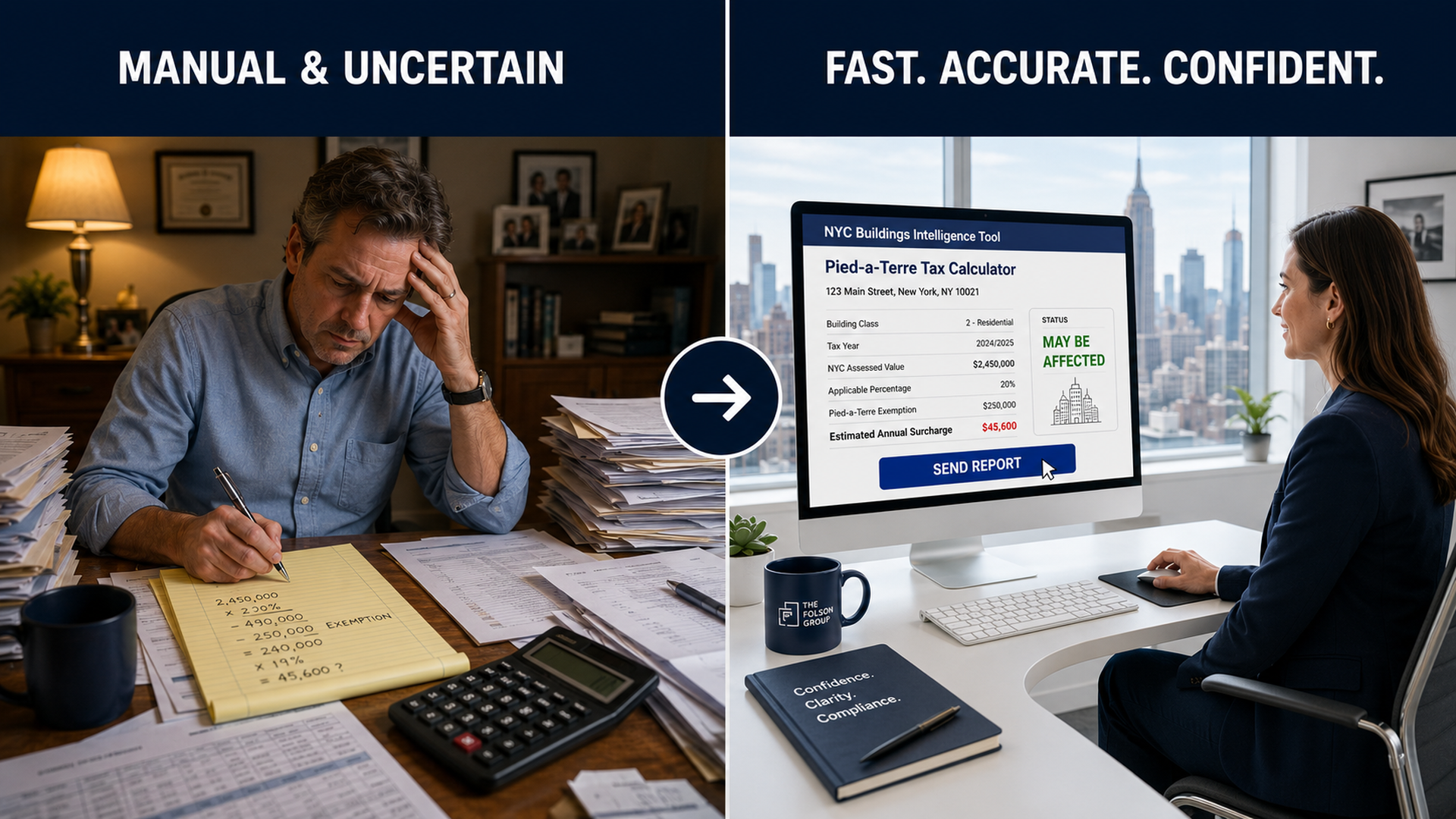
If you own, buy, sell, or help manage New York City real estate, there is a new tax you should know about.
The new NYC pied-à-terre tax officially took effect on July 1, 2026, and in the coming weeks, many apartment owners will begin receiving letters from the New York City Department of Finance.
If your phone tends to ring whenever something new impacts NYC real estate, it may be about to ring again.
Here's what you need to know.
What Is the Pied-à-Terre Tax?
The new law creates an annual surcharge on certain New York City apartments that are not the owner's primary residence.
Here's who this matters to.
Maybe you live somewhere else and keep a second apartment in the city, or even have more than one apartment here.
Maybe you are planning to buy a place in New York so you can enjoy the city a little more.
Or maybe you are thinking about spending half the year in Florida to avoid New York taxes.
If you live in your apartment as your primary residence, this tax generally does not apply.
The Number That Really Matters
One of the biggest misconceptions is that this tax is based on what an apartment could sell for.
It isn't.
The calculation is based on the property's NYC Assessed Value, not its market value.
For co-ops and condominiums, assessed values are often significantly lower than the price you see on listing websites. That means two apartments with similar market values could have very different tax outcomes.
Before making assumptions, it's important to look at the city's assessed value for the building.
Why This Tax Hits Condos and Co-ops Differently
The same tax lands very differently depending on whether you own a condo or a co-op. It comes down to how the city records each one.
Every property in NYC has a BBL, short for Borough, Block, and Lot. It's the tax ID for a piece of real estate. In a condo building, each apartment has its own BBL, so it's its own tax lot. That means the Department of Finance can bill a non-primary condo owner directly. One apartment, one BBL, one bill. Whether the city has the right information about who lives there is a separate question, but the mechanism is clean.
Co-ops work nothing like that. The whole building shares one BBL. When you buy into a co-op, you aren't buying real estate, you're buying shares in a corporation, and those shares equal a percentage of the building's assessed value. There's no separate tax lot for the city to bill.
So unless the law changes, the city can't bill shareholders directly. It can only bill the corporation. That leaves the co-op responsible for collecting the surcharge from every non-primary resident and remitting it to the city.
For boards and property managers, that's a real headache: figuring out who's non-primary, calculating each one's share by ownership percentage, collecting it, and fielding every shareholder who insists they're exempt. Most boards are not staffed for that.
Our calculator handles both cases, whether the city bills you directly as a condo owner or you're a board trying to see how the surcharge breaks down across shareholders.
The First Important Date
The Department of Finance is expected to notify affected owners by August 30, 2026.
Based on our experience working with NYC co-op and condo boards for more than a decade, we know what usually happens next.
Owners call their board or property manager.
Boards call their property manager.
Buyers call their broker.
Everyone is asking the same questions:
Does this apply to me?
How much will I owe?
What should I do next?
Why This Matters Beyond Apartment Owners
This isn't just an issue for owners.
Real estate brokers are already being asked about potential tax exposure during buyer conversations.
Co-op and condo boards may receive questions from concerned shareholders and unit owners.
Property managers will likely be asked to help explain what the notices mean.
Real estate attorneys, the trusted advisors for many buyers, sellers, and owners, are getting the same calls.
Having accurate information before those conversations happen puts everyone in a much better position.
We Built a Free Calculator to Help
At The Folson Group, we believe complicated rules should be easier to understand.
That's why we built a free Pied-à-Terre Tax Calculator. It's inside our NYC Buildings Intelligence Tool, which has other valuable information for building operators.
Simply enter a New York City address and our tool pulls information directly from public city records to estimate whether the building, and even a specific apartment, may be affected, and provides key property details in seconds.
No login.
No subscription.
No cost.
Whether you're a broker preparing for client questions, a board member trying to stay ahead of the next meeting, or simply an owner who wants to understand the new law, it's a quick place to start.
Knowledge Creates Better Decisions
New laws always bring uncertainty.
The more you understand the numbers before the notices arrive, the better prepared you'll be to answer questions and make informed decisions.
At The Folson Group, we've spent more than 12 years helping NYC co-op and condo boards understand complex financial and operational issues, identify opportunities to reduce costs, and run their buildings like a business.
The pied-à-terre tax may be new.
Helping people understand complicated building issues isn't.
Disclaimer: This article is provided for informational purposes only and should not be considered legal, tax, or financial advice. Please consult your attorney, CPA, or other qualified advisor regarding your specific situation.