Local Law 97 Is Not a Future Problem: Why Your NYC Co-op or Condo Board Should Be at the NYC Accelerator Expo on October 14
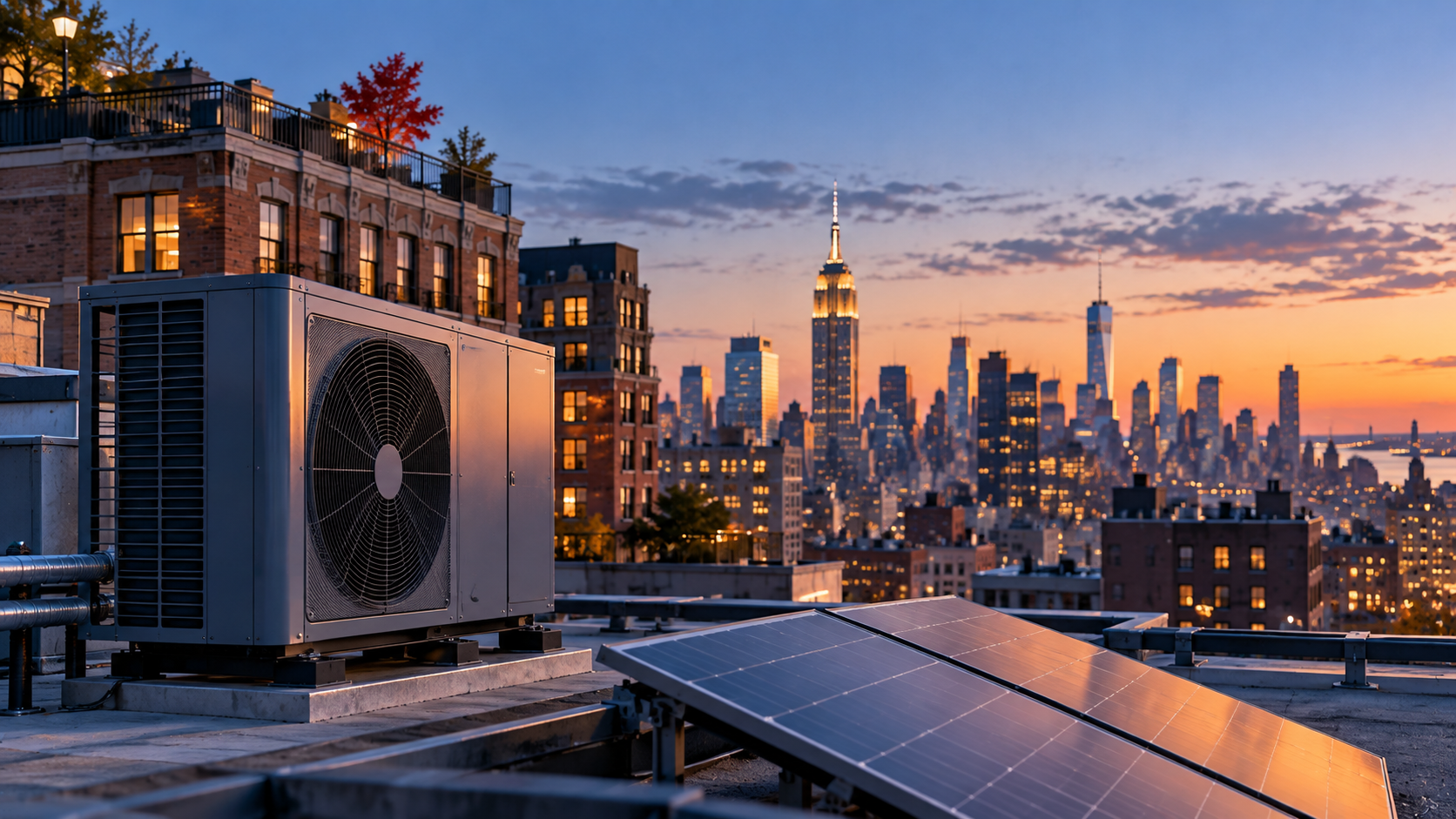
Illustration of prewar NYC apartment buildings at golden hour with a small red leaf on the tallest rooftop, representing lower emissions under Local Law 97.
Quick question. Does your board know your building's Local Law 97 emissions limit?
Not roughly. The actual number.
If the answer is a long pause followed by "I think our manager handles that," keep reading.
You are not alone, and you still have time.
But the clock is running, and next Wednesday gives you a free way to get ahead of it.
Why Local Law 97 Matters to Your Wallet
Local Law 97 puts a cap on the carbon emissions of most NYC buildings over 25,000 square feet. Go over your limit, and the city charges $268 for every metric ton above it. Every year.
Here is what that looks like.
A building 200 tons over its limit owes $53,600 annually.
Do nothing, and you owe it again next year. And the year after that.
That is not a one time fine.
It is a recurring line item, and it lands on the same people every time: your shareholders or unit owners, through maintenance, common charges, or an assessment.
The limits also get stricter in 2030. A building that squeaks by today may not tomorrow.
Local Law 97 in Plain English
Most NYC coop and condo buildings over 25,000 square feet are covered.
Every year, you report your building's emissions to the city. Go over your limit, and you pay.
Your limit depends on your building's size and type.
The questions your board should be able to answer:
Is our building covered?
What is our limit, and where do our actual emissions sit?
Was our most recent report filed, and by whom?
If we are over, by how much, and what would it cost to fix versus pay?
If your board cannot answer all four in under a minute, that is your first agenda item.
What This Means for Your Building
The board. Fiduciary duty does not stop at the budget. A known liability that nobody has priced is exactly the kind of thing that looks bad later.
The owner's wallet. Penalties, or the retrofit work that avoids them, get paid by owners. The only question is whether you plan for it or get surprised by it.
Property value. Buyers, lenders, and their attorneys are asking about Local Law 97 now. A building with a clear plan looks like a well run business. A building with no answers looks like a risk.
The workload. Your board is made up of volunteers. Nobody signed up to become an energy engineer. That is exactly why the next section matters.
Why the NYC Accelerator Expo Is Worth Your Wednesday Afternoon
On Wednesday, October 14, 2026, from 12 PM to 6 PM, the NYC Accelerator Expo takes over the Metropolitan Pavilion at 125 W 18th Street in Manhattan.
It is free to attend.
The idea is simple.
Instead of chasing a dozen different people over six months, you meet the people who can actually move an energy project forward, all in one room:
Contractors who do this work
Capital providers who can talk financing
NYSERDA, to understand state energy efficiency programs
Con Edison and National Grid, for programs and incentives
The NYC Department of Buildings (DOB), for one on one help with Local Law 97 and other building energy laws (this is a separate sign up, so grab a slot early)
Educational sessions on financing, weatherization, and LL97 compliance
You leave with contacts and concrete next steps.
For a volunteer board, that is worth more than another six months of "we should look into that."
How to Walk In Like a Business Owner
An expo is only useful if you show up with questions.
Otherwise you collect tote bags.
Before you go, pull together:
Your building's most recent LL97 report, or confirmation from your managing agent that it was filed
The age and type of your boiler and heating system
Your recent energy and utility costs
Any capital plan or reserve study you already have
Then ask every contractor and provider the same questions, so you can compare answers fairly:
What exactly would you propose for a building like ours, and why?
What is the full cost, including permits, engineering, and anything not in your quote?
What incentives or financing apply, and who applies for them?
What happens to our emissions number after the work, and how is that proven?
Who is responsible if the savings do not show up?
Notice what you are doing.
You are not buying anything on the spot.
You are gathering information and testing assumptions, the way you would before any major business decision.
Folson's Perspective
We say it all the time: a coop or condo is not just a home.
It is a business with a very large balance sheet.
When we organized a coup at our own co-op, the savings did not come from heroics.
Over three years, we saved the building $340,000 by asking basic questions about every contract and every line item.
Who is this vendor? What are we paying? What would it cost somewhere else?
Local Law 97 deserves the same treatment.
The boards we see doing well here are not the ones with the most technical knowledge.
They are the ones who ask better questions, compare options, and refuse to be rushed.
What to Do Next
Find out if your building is covered and confirm your latest report was filed.
Put Local Law 97 on your next board agenda. Ten minutes is enough to start.
Register for the Expo and sign up for the DOB one on one session if you want it.
Bring a second person. Two sets of ears catch more than one.
Check your other deadlines on the NYC Compliance Calendar, because Local Law 97 is rarely the only one.
The Bottom Line
Your building may be a home, but financially, it is a business.
Businesses do not wait for the penalty notice to find out what they owe.
Come Say Hello
We will be at the NYC Accelerator Expo, and we would love to meet you. Stop by our booth, and bring your questions.
No pitch. Just a real conversation about where your building stands.
Cannot make it, or want more time than a busy expo floor allows? Schedule a free consultation with The Folson Group and we will walk through your Local Law 97 situation together.
Feel free to share this article with your board, too.
Ready to go? Register for the free NYC Accelerator Expo on Eventbrite