Local Law 157: NYC Gas Detector Deadline Is Jan 1, 2027
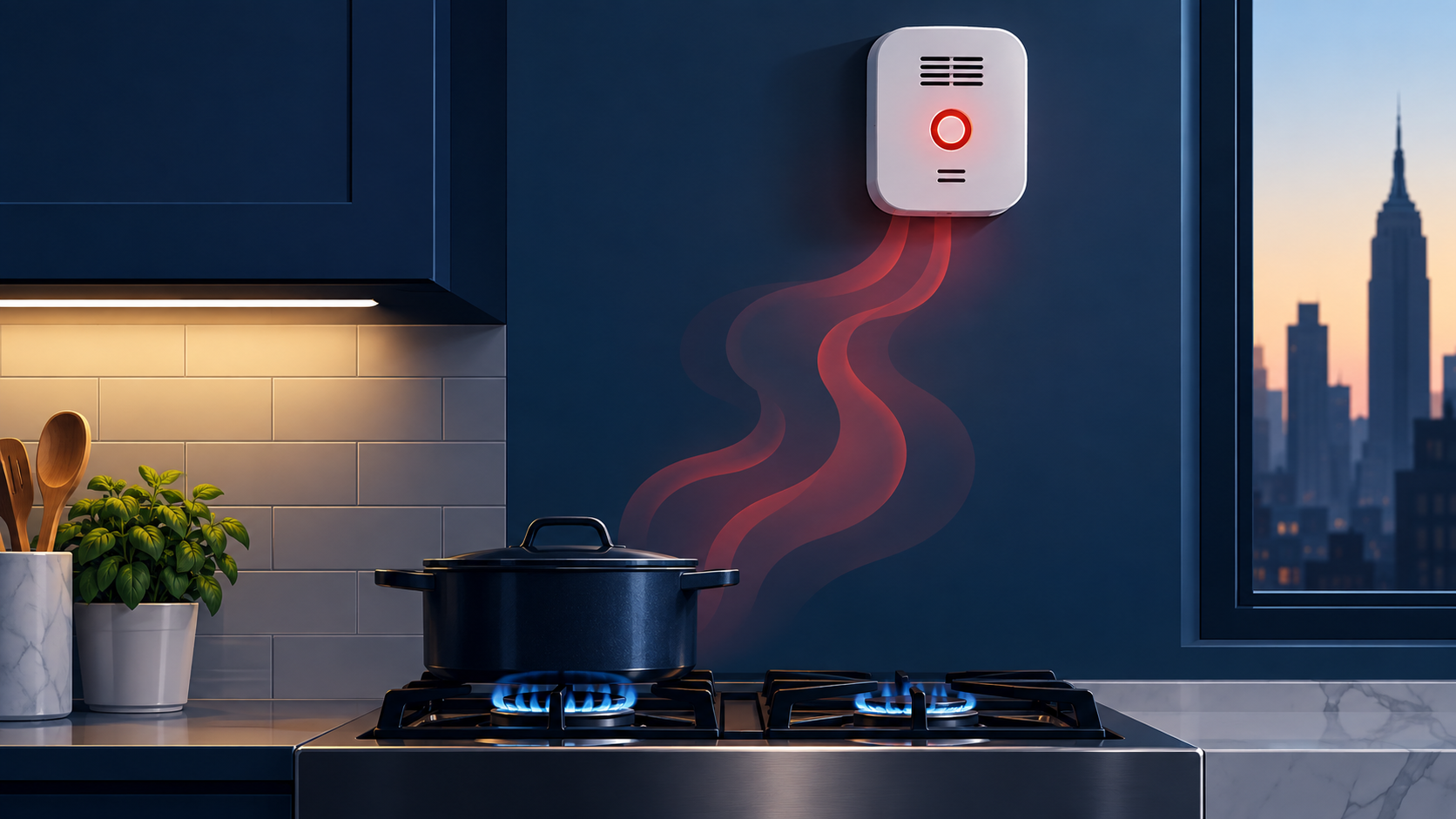
Illustration of a NYC apartment kitchen with a gas stove and pot, a red-lit natural gas detector on the wall, and red vapor-like lines connecting the stove to the detector. The Empire State Building is visible through the window, representing NYC Local Law 157 requirements for natural gas detectors.
For about two years, a lot of NYC boards quietly treated the gas detector rule as someone else's problem. The deadline kept moving. The approved devices barely existed. The smart money assumed it would slip again, maybe all the way to 2029.
That assumption just expired.
On June 15, 2026, the Department of Buildings issued a short service notice that changed the math. Natural gas alarms must be installed in covered residential buildings on or before January 1, 2027, and the city confirmed the date will not be pushed any further.
If your building has gas heat, stoves, dryers, or any other appliances or devices running on natural gas, that deadline is now definitive.
Why the Deadline Suddenly Became Real
Here is the part most boards missed. The deadline was never really about the calendar. It was about supply.
When the City Council passed Local Law 157, the deadline was May of 2025. Because there was only one approved alarm, which led to a supply shortage, they later passed Local Law 102 that was tied to one condition. If the city could not identify at least four different manufacturers making battery-powered natural gas alarms, the deadline could slide to January 1, 2029. If it could find four, that deadline would be January 1, 2027.
The city found four.
So 2027 holds. That single detail is the whole story, and it is the reason the "let's wait and see" strategy no longer works. The devices exist now. The city said so in writing. The escape hatch to 2029 is closed.
Quick Clarification: This Is Local Law 157, Not Local Law 152
These two get mixed up constantly, and confusing them can cost you.
Local Law 157 is the gas alarm law. It requires natural gas detectors inside dwelling units. That is the one with the January 1, 2027 deadline.
Local Law 152 is the gas piping inspection law. It requires a licensed inspection of your building's exposed gas piping on a recurring cycle tied to your community district.
Different laws, different deadlines, different work. If someone on your board says "we handled the gas thing," make sure you know which gas thing they mean. Handling one does not handle the other.
What Local Law 157 Actually Requires
Strip away the noise and the requirement is straightforward. Covered buildings must install natural gas alarms that meet the city's standards.
In plain English, that means:
At least one alarm in every dwelling unit that has natural gas service.
In rooms with a gas-burning appliance, the alarm goes 3 to 10 feet from the appliance.
On the ceiling, or on the wall within 12 inches of the ceiling. Natural gas is lighter than air, so it rises. The device has to be up where the gas actually goes.
The device must be listed to UL 1484 or UL 2075 and comply with the NFPA 715 standard the city adopted.
A natural gas alarm is not the same as a smoke alarm or a carbon monoxide alarm. Your existing detectors do not cover you here. This is a separate device doing a separate job.
One more practical note. These alarms have a limited service life and carry a manufacturer expiration date. They are not a buy-it-once item. Whatever the board installs in 2026 will need to be tracked and replaced after the battery’s useful life, which is typically 10 years.
Who Has to Comply, and Who Is Off the Hook
The law reaches almost every residential building in the city that uses gas.
That includes Class A multiple dwellings, which is where most co-ops and condos live, along with rentals. It also includes Class B dwellings like hotels, dorms, and single room occupancies, and many one and two family homes that are not owner occupied.
The clean exemption is simple: buildings and units with no gas service and no gas piping. If your building is fully electric, this one does not apply to you. If you have gas anywhere feeding units, plan on complying.
There is a governance wrinkle worth surfacing at your next meeting. In a co-op, the corporation is the owner, so the obligation sits squarely with the building. In a condo, responsibility can land on individual unit owners, which sounds like less work for the board until you picture 80 owners each buying a random device off the internet and installing it wherever they feel like it.
That is not compliance. That is chaos with a receipt. Either way, the board is the one that needs a plan.
The Trap Most Boards Will Walk Into
Here is where a rushed decision gets expensive, and this is a judgment call, not a legal line, so read it as strategy.
The law only requires a compliant alarm. It does not tell you which one to buy. The temptation, especially with a deadline bearing down, is to grab the cheapest UL-listed device, install one per unit, check the box, and move on.
Think about what that box actually does.
A basic alarm senses gas and screams. That is it. When it goes off at 2 a.m. in a unit whose owner is in Florida for the winter, nobody hears it, or a neighbor does and calls 911. And the first thing the city or the utility does when gas is reported is shut the gas off.
Getting gas turned back on in a NYC building is not a phone call. It can mean pressure tests on the risers, inspections, paperwork, and weeks or months of a building with no cooking gas and sometimes no heat or hot water, plus the repair bills that come with it. Boards have spent staggering sums digging out of a gas shutoff.
That does not mean you overspend. It means you make an informed choice instead of a panicked one. A monitored device that also alerts management costs more up front and may spare you a shutoff that costs a hundred times as much.
What Should Your Board Do Now?
The January 1, 2027 deadline may sound like it is still a few months away.
It isn't, especially if your building has dozens or hundreds of apartments and you need to coordinate access.
The device itself may be the easiest part.
The logistics are often where the work is.
Here are the questions I would put on your next board meeting agenda. Or even better, send your request out for a board vote via email today!
1. Do we actually have natural gas?
Start with the basics.
Confirm which apartments and common areas have natural gas service and where gas-burning appliances are located.
You need to know your scope before you can price the project.
2. How many apartments are affected?
Once you know where gas exists, determine how many units require alarms.
Then think about how you will get access to those apartments.
If your building needs to enter 100 apartments, the scheduling process can become a project in itself.
Do not leave that until December.
3. Are we considering basic or monitored alarms?
Ask vendors to price both options if both are appropriate for your building.
More importantly, ask them to explain what happens when an alarm activates.
Who gets notified?
Who responds?
What happens if the apartment is vacant?
What happens if the alarm is triggered in the middle of the night?
4. Who will install the devices?
The installation requirements can depend on the type of device selected.
Battery-powered and plug-in devices can have different installation considerations from hardwired devices.
If hardwired devices are being considered, ask about the electrical contractor, permits and inspection requirements that may apply.
Do not assume that because the device itself is simple, the installation is automatically simple.
5. What exactly are we buying?
Do not settle for a vendor telling you that a product is "approved."
Ask for the documentation.
Confirm that the device meets the applicable requirements, including the relevant UL listing and NFPA 715 requirements.
Your board should have a record of exactly what was purchased and installed.
6. Who is responsible for tracking replacement dates?
This is an easy one to overlook.
If the devices have a defined service life, someone needs to own that information.
Your managing agent may be the right person.
Your superintendent may be involved.
Your board may want it incorporated into the building's compliance tracking dashboard. If you don’t have one, reach out to us and we can set one up for you.
Whatever approach you choose, decide now.
Red flags to watch for: a vendor who cannot name the UL listing, a "package price" that hides the labor, a plan that assumes every owner will handle their own unit with no oversight, and anyone telling you the deadline might still slip. It might not.
The Bottom Line
The city stopped kicking this one down the road. The devices exist, the date is set, and the only question left is whether your board handles it early and on your terms, or late and on someone else's.
A gas alarm is a cheap device guarding an expensive risk. Buy it like you understand the difference.
Talk It Through Before You Buy
If your board is not sure where to start, or you want a second set of eyes before you sign a vendor agreement, that is exactly the kind of decision The Folson Group helps boards get right.
You can check your building's other upcoming deadlines on the NYC Compliance Calendar, look up your building with our free building tool, or reach out to us directly to walk through your options.
Bring your questions.
That is what we are here for.