Local Law 97 Deadline 2026: What NYC Co-op & Condo Boards Must Know Now
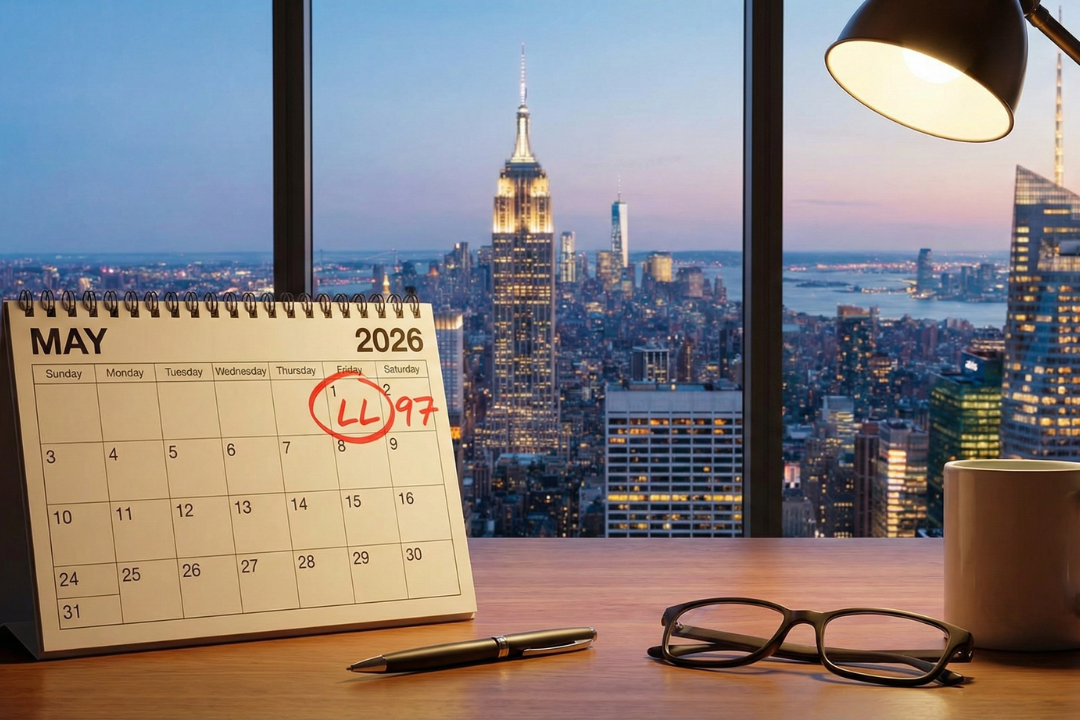
The 2026 Countdown: The Local Law NYC Boards Can’t Afford to Ignore
(NYC compliance & co-op compliance made simple)
You know that feeling when a deadline seems way off in the distance… until suddenly it’s staring you in the face?
That’s exactly where thousands of NYC co-op and condo buildings are right now with Local Law 97.
And if your building wasn’t required to file in 2025?
Then 2026 is your year.
What You Need to Know Right Now
2026 is the first official compliance year for a huge number of buildings—many of which have no idea they’re on the hook. If your property wasn’t required to submit a 2025 report, then your very first Local Law 97 filing is due May 1, 2026, based on your 2025 emissions.
Not sure whether your building is covered or whether you already missed a deadline?
The City maintains a Covered Buildings List, and it gets updated. Quietly. Regularly. And it’s your responsibility as a board to check it for NYC compliance and co-op compliance purposes.
If you haven’t looked lately… look again.
Which Buildings Are Up First?
If you’re on the Covered Buildings List and didn’t have to file in 2025, you’re in the 2026 wave. While you need to refer to the Covered Building List, the 2026 deadline applies primarily to:
Buildings with one or more rent-stabilized units
Co-ops or condos where the sponsor still owns stabilized apartments
Residential buildings that meet the size thresholds—even if they never had to comply with Local Law 84 or 87 before
Mixed-use properties that fall into the emissions reporting category
These buildings make up one of the fastest-growing categories of new LL97 compliance cases across NYC.
What’s Actually Required in 2026
Think of 2026 as the “prove you’re paying attention” year. The City is expecting you to show that your board is taking NYC compliance seriously. Here’s what you’ll need to do:
Confirm your building is on the Covered Buildings List
Identify your specific emissions limit
Review and analyze your energy usage and carbon output
Map out long-term compliance strategies and funding
Prepare to submit your first emissions report on May 1, 2026
Here’s where many boards stumble:
They think they’re exempt because they’re “mostly residential” or because they have rent-stabilized units.
But LL97 doesn’t care about assumptions.
It cares about facts—and the list.
The Most Overlooked Requirement: HVAC or Boiler Controls
Let’s talk about one of the most consistent (and costly) compliance gaps we see across NYC.
Most buildings assume that their BMS or EMS makes them compliant.
But under Local Law 97, that’s not enough.
Here’s the actual requirement:
👉 At least 25% of the apartments must have interior temperature sensors connected to the control system.
This is where most buildings fall short.
Some buildings have only a handful of sensors.
Some have sensors that aren’t tied into the control system.
And some are still running on outdoor-reset controls that adjust the boiler based on the weather outside—a system that was cutting-edge in 1985 but is nowhere near LL97 standards.
Why this matters for co-op compliance and NYC compliance:
Old boiler controls cause overheating
Overheating drives higher fuel consumption
Higher fuel use means higher emissions
Higher emissions = avoidable LL97 fines
Upgrading controls may not be exciting, but it’s one of the fastest, cheapest, and most reliable ways to cut energy waste and keep your building on the right side of LL97.
Why This Matters
If your building needs to comply in 2026 and you haven’t started preparing, you’re setting your board up for:
Rush projects
Emergency spending
Super-sized assessments
Avoidable penalties
Stressful annual meetings with unhappy shareholders or unit owners
LL97 isn’t about being perfect by 2026—it’s about demonstrating that you understand your obligations and have a plan to meet them.
Boards that start early stay calm.
Boards that wait scramble.
Ready to Make 2026 Feel Less Overwhelming?
If you want help checking whether your building is actually on the Covered Buildings List—and whether your boiler controls will pass LL97 requirements—reach out and let’s take a look together.
The earlier you start your NYC compliance plan, the smoother your 2026 will feel.